
An in-depth guide for contractors, project managers and fleet operators
Government contracts and tenders represent some of the most stable and lucrative revenue opportunities in the infrastructure and services sector. Whether you work in civil construction, utilities, transport, or facilities management, winning and successfully delivering government work depends on more than price — it hinges on compliance, performance and operational excellence.
One of the biggest compliance areas assessed in government procurement is fleet compliance. This includes vehicle safety, maintenance, environmental performance, documentation, and risk mitigation. In 2026, the expectations around fleet compliance are stricter and more comprehensive than ever before.
In this article, we’ll unpack:
✅ What Government Tenders Are Looking For
✅ Why Fleet Compliance Is Critical
✅ Key Compliance Areas in 2026
✅ Common Pitfalls & Risks
✅ Practical Steps to Achieve Compliance
✅ How Trend Rentals Supports Government Contractors
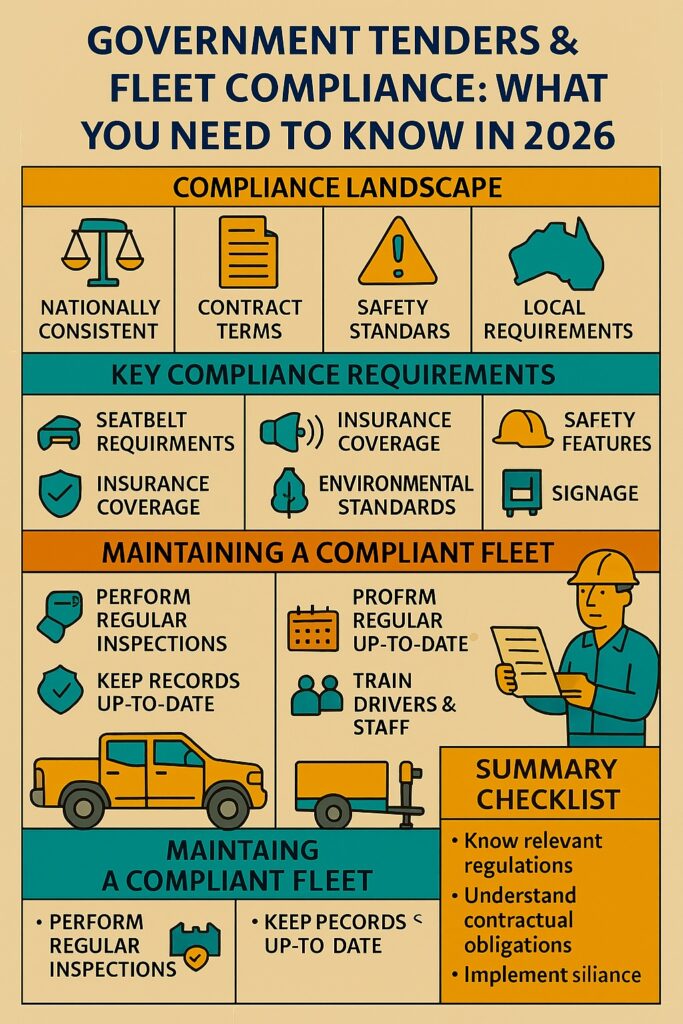
Government Tenders: The Compliance Landscape in 2026
Government agencies — at federal, state and local levels — are moving beyond lowest-cost procurement. They now evaluate suppliers on capability, risk management, safety performance, environmental sustainability, and compliance with regulations.
Fleet compliance sits at the intersection of these criteria. Poor oversight of vehicles and mobile plant can cause safety incidents, project delays, cost blowouts and public liability claims — all of which governments want to avoid.
In short, if your fleet doesn’t meet compliance expectations, your tender bid may be unsuccessful, your contract may be rescinded, or your performance can be penalised.

Why Fleet Compliance Matters for Government Contracts
🚨 1. Safety & Risk Management
Government tenders increasingly prioritise workplace safety. A compliant fleet demonstrates:
- vehicles serviced and inspected on schedule
- documented maintenance records
- trained and approved operators
- hazard and incident reporting systems
This signals to procurement teams that your organisation reduces risk — a non-negotiable requirement in major contracts.

🌱 2. Environmental & Sustainability Requirements
Many government tenders now include environmental scoring or sustainability plans. Fleet compliance plays a role here through:
- emissions reporting
- low-emission vehicle use
- fuel efficiency programs
- electric or hybrid vehicle strategies
Meeting environmental standards can enhance your tender score and help you win more contracts.

🏛 3. Legal & Regulatory Certainty
Governments must award contracts to suppliers who are legally compliant and demonstrate full regulatory adherence. A compliant fleet protects you from:
- fines and penalties
- contractual breaches
- litigation risk
- reputational harm
Being able to prove compliance with documentation during evaluations is essential.

📈 4. Operational Efficiency
Compliant fleets are more reliable. Fewer breakdowns, reduced downtime and safer operations translate to:
- better project delivery outcomes
- lower operating costs
- stronger performance metrics
- repeat business opportunities

What 2026 Government Tenders Are Looking For
Let’s break down the specific fleet compliance requirements that government procurement panels are now evaluating.
🔎 1. Comprehensive Vehicle Documentation
Government tenders often require sighting or submitting:
✔ registration certificates
✔ inspection reports
✔ service history
✔ compliance tags
✔ operator qualifications
✔ risk assessments
✔ incident logs
This is not optional — it’s a scoreable component of many tender evaluations.
Trend Rentals Tip: If you hire vehicles through us, we provide compliance documentation for every item.

👷♂️ 2. Operator Training Credentials
Procurement teams want confirmation that every vehicle operator has:
- a valid licence classification
- relevant training or competencies
- site induction records
- up-to-date safety certifications
This may involve audited training databases, digital logs, or credential verification platforms.

🛠 3. Scheduled Maintenance & Preventative Care
You should be able to show:
- planned maintenance frameworks
- evidence of completed servicing
- corrective maintenance history
- defect remediation records
These records must be easily accessible and verifiable.

📲 4. Digital Systems & Traceability
Many tenders now include requirements for:
- telematics or GPS tracking
- digital inspection checklists
- centralised maintenance platforms
- real-time reporting
This replaces outdated paper-only systems and improves transparency during performance reviews.
📊 5. Performance Metrics & KPIs
Governments increasingly ask bidders to demonstrate key performance measures, such as:
- on-time delivery of services
- incident and near-miss statistics
- fleet utilisation metrics
- emissions reporting
This means your compliance system isn’t just about safety — it’s about measurable performance.

Key Compliance Areas Assessed in Government Tenders
Below are the most commonly evaluated components related to fleets.
✔ Registration & Certification
Every vehicle must have:
- national/state registration
- required safety certifications
- proof of roadworthiness
If a tender covers specialised vehicles (heavy plant, mobile cranes, restricted access vehicles), additional certifications may apply.
✔ Maintenance Systems
This includes:
- documented maintenance schedules
- evidence of inspections
- corrective actions documented
- regulatory standards mapped to tasks
✔ Safety Systems / Risk Management
Government tender panels want evidence your organisation:
- conducts risk assessments
- updates safe operating procedures
- reports and learns from incidents
- enforces standards consistently
Your fleet compliance programs are a major part of this.
✔ Environmental & Emissions Reporting
Governments require:
- current emissions data
- fleet electrification plans (where applicable)
- energy usage and fuel consumption tracking
- strategies to reduce carbon footprint
These requirements are now embedded in many infrastructure, services and facilities contracts.
✔ Data & Digital Reporting
Paper forms are being replaced with:
- electronic inspection records
- telematics feeds
- automated compliance flags
- cloud-based audit trails
If your fleet can’t present digital reports, you may lose points during tender evaluation.
Common Pitfalls & Compliance Risks
Even experienced contractors can fall short. Here are frequent errors that cost compliance scores or contract performance:
❌ Incomplete Documentation
Missing or illegible inspection reports, unknown service records, or unverified driver credentials are common bidder mistakes.
❌ Outdated Compliance Systems
Some organisations still rely on paper logs or fragmented spreadsheets — which make audits slow and error-prone.
❌ Lack of Maintenance Planning
If you cannot prove that a vehicle was serviced before it was needed on a government project, it’s a red flag.
❌ Reactive Instead of Proactive
Waiting until a vehicle fails inspection — rather than planning maintenance — introduces risk and signals poor operational discipline.
❌ Poor Digital Traceability
Without telematics, cloud-based inspections or centralised records, compliance documentation can’t be produced quickly during evaluations.
Practical Steps to Achieve Fleet Compliance for Tenders
Whether you’re bidding for your first government contract or renewing your compliance system, here’s a structured approach.
➤ 1. Audit Your Current Systems
Start by assessing:
✔ vehicle documentation completeness
✔ maintenance logs
✔ training and driver credentials
✔ inspection systems
✔ digital reporting tools
Identify gaps and create a corrective action plan.
➤ 2. Develop Standard Operating Procedures (SOPs)
Document:
✔ how vehicles are inspected
✔ how maintenance is scheduled
✔ who verifies driver credentials
✔ how incidents are recorded
These procedures become part of your tender submission.
➤ 3. Adopt Digital Tools
Government evaluators expect digital records. Consider:
- cloud-based compliance platforms
- mobile inspection apps
- telematics for vehicle tracking and fault alerts
- maintenance scheduling software
Digital systems simplify tender deliverables and operational tracking.
➤ 4. Train and Verify Competency
Your workforce should have:
✔ current licences
✔ training certificates
✔ site induction records
✔ refresher training schedules
This is often submitted as part of workforce compliance evidence in tenders.
➤ 5. Create a Preventative Maintenance Program
Document:
- frequency of checks
- servicing timelines
- records of parts replacements
- defect correction plans
This demonstrates planned risk mitigation, not reactive fixes.
➤ 6. Build an Audit Library
Organise all records so that any compliance assessor can retrieve them within minutes:
- service logs
- inspection reports
- driver competency evidence
- telematics summaries
- incident history
This is vital during tender evaluations and post-award performance reviews.
➤ 7. Align Fleet Strategy with Contract Requirements
Government tenders will often specify:
- emissions targets
- environmental outcomes
- safety KPIs
- delivery performance
Tailor your fleet compliance systems to align directly with these expectations.
How Trend Rentals Supports Compliance for Government Contractors
At Trend Rentals, we know that contractors need more than equipment — they need compliance-ready solutions that help them win tenders and execute projects confidently.
Here’s how we help:
🔧 1. Compliance-Ready Fleet
All vehicles and equipment available for hire are:
✔ serviced to manufacturer standards
✔ inspected and safety-checked before dispatch
✔ accompanied by compliance documentation
✔ maintained to regulatory requirements
Whether you need utes, trucks, trailers or specialised plant, we deliver items that come with documented proof of compliance.
📄 2. Documentation Support
We provide:
- inspection certificates
- maintenance logs
- safety checklists
- compliance tags
These make it easier for you to compile tender responses that require specific fleet evidence.
👷♂️ 3. Training & Operational Guidance
Trend Rentals offers guidance on:
✔ safe operation
✔ pre-hire inspection best practices
✔ record-keeping essentials
✔ fleet compliance planning
This helps you build internal capability aligned with government expectations.
🛠 4. Flexible Hire Periods for Tender Requirements
Government contracts often involve staged deliveries, pilot programs, or short-term milestones.
Our flexible hire terms let you scale your fleet up or down without long-term capital commitments — a key advantage when project requirements shift.
🧑💻 5. Digital Asset Traceability
We support digital procedures by providing data in formats that can be integrated into your compliance systems — which is ideal for tender submissions that demand digital evidence.
Case Studies: Fleet Compliance in Government Projects
Here are two illustrative examples of how fleet compliance impacted government contract success in 2026.
Case Study 1: Urban Road Upgrade Project
Challenge:
Bid included delivery of materials, inspections and site access responsibilities — assessed heavily on safety, reliability and documentation.
Action Taken:
The contractor:
- digitised their fleet inspection system
- ensured all vehicle compliance records were cloud-accessible
- provided Trend Rentals vehicles with full documentation
Outcome:
✔ Successful tender award
✔ No compliance issues during project delivery
✔ Zero safety incidents
Case Study 2: Regional Infrastructure Maintenance Contract
Challenge:
Contract required low emission vehicles, strict safety KPIs and evidence of continual improvement.
Action Taken:
The team:
- produced emissions reports for their fleet
- introduced monitoring telematics
- submitted compliance evidence with tender
- used Trend Rentals vehicles to supplement their fleet where needed
Outcome:
✔ High tender score for compliance and sustainability
✔ Project delivered ahead of schedule
✔ Repeat engagement offered
Checklist: Preparing Your Fleet for Government Tenders
Use this checklist to ensure your fleet compliance system is ready for 2026 government procurement demands:
🧾 Documentation
✔ Registration certificates
✔ Inspection reports
✔ Service history records
✔ Compliance tags attached
✔ Digital storage accessible
👥 Operator Compliance
✔ Valid driver licences
✔ Training certificates
✔ Site induction evidence
✔ Refresher training schedules
🔧 Maintenance
✔ Scheduled maintenance plan
✔ Completed servicing records
✔ Defect correction logs
✔ Preventative systems adhered to
📲 Digital Systems
✔ Telematics in place
✔ Mobile inspection reporting
✔ Cloud-based records
✔ Real-time reporting capability
📊 Performance Tracking
✔ Safety KPIs monitored
✔ Emissions recorded
✔ Incident reporting analysed
✔ Operational efficiency metrics
Final Thoughts: Government Tenders & Fleet Compliance in 2026
Fleet compliance has shifted from a “nice-to-have” to a must-have element in government procurement. It is no longer enough to simply own vehicles — you must be able to prove compliance through:
📍 documentation
📍 digital systems
📍 measurable performance
📍 safety management
📍 environmental reporting
Getting these right will help you:
✔ win more government tenders
✔ deliver projects safely
✔ reduce risk
✔ improve operational performance
✔ enhance your reputation