What every contractor, project manager & site safety officer needs to know

As infrastructure development accelerates globally — and particularly across Australia — 2026 marks a pivotal year for how projects manage site vehicles, safety compliance, and operational efficiency. With billions of dollars allocated to roads, rail, utilities, and public works, organisations must juggle resource delivery with strict regulatory requirements, risk management, and environmental stewardship.

At Trend Rentals, we’ve witnessed the evolution of compliance expectations, and we’re committed to empowering your projects with safer vehicle use and smarter solutions. This deep-dive explores:

  • Why site vehicle compliance matters now more than ever
  • Emerging trends reshaping compliance practices in 2026
  • Risks associated with non-compliance
  • Practical strategies to achieve compliance
  • How Trend Rentals helps future-proof your infrastructure fleet
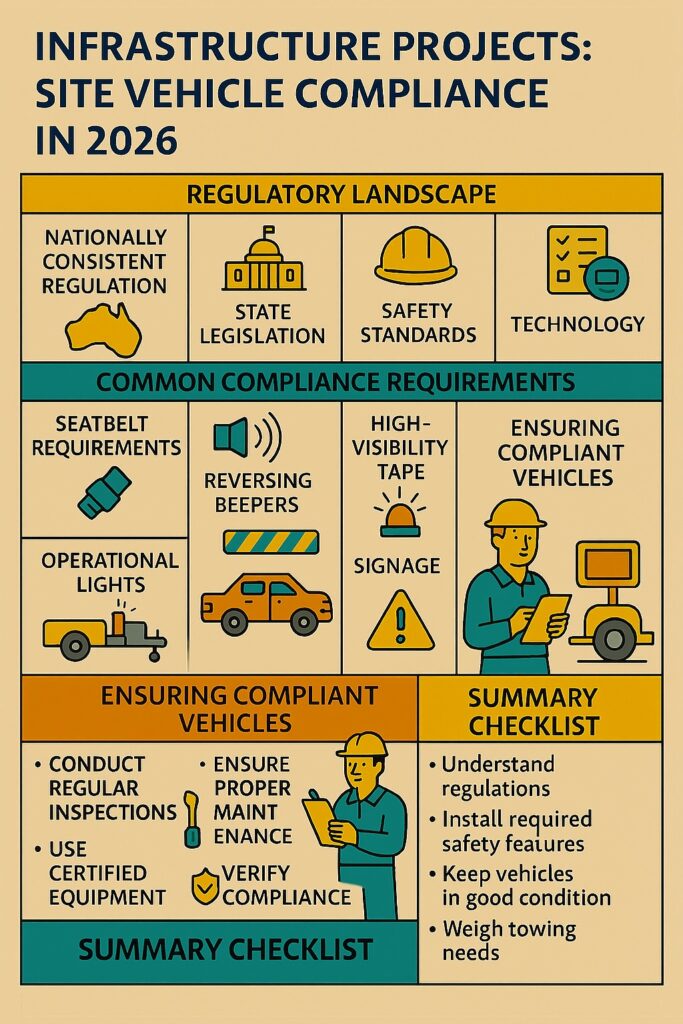
infographic Infrastructure Projects & Site Vehicle Compliance in 2026

Why Site Vehicle Compliance Matters in 2026

1. Scale of Infrastructure Growth

Australians will see continued major investment in:

  • transport corridors
  • urban renewals
  • energy and utilities expansion

These projects require constant movement of materials, equipment and personnel — often in complex environments where multiple contractors operate. That means thousands of vehicles on and off sites daily.

Proper regulatory adherence protects lives, minimises delays, and reduces costs over the project lifecycle.


2. Stricter Safety Regulations

Workplace health and safety organisations — including SafeWork Australia and state regulators — have extended expectations around:

✔ vehicle maintenance and inspection schedules
✔ driver competency and licensing
✔ risk assessments associated with mobile plant
✔ documentation and record keeping

Failure to comply can result in fines, work stoppages, or legal liabilities.

Trend Rentals products and checklists can help support these requirements.

Stricter Safety Regulations

3. Community & Environmental Expectations

Communities increasingly demand:

  • lower emissions
  • reduced noise
  • less disruption
  • better site practices

Vehicle fleets that ignore these expectations can encounter public opposition or project delays — especially in urban infrastructure works.

Community & Environmental Expectations

2026 Key Trends in Site Vehicle Compliance

Let’s explore the major trends driving change:


🚛 1. Digitised Vehicle Compliance & Reporting

Gone are manual logs and paper tags.

In 2026, infrastructure sites are using:

  • cloud-based inspection reports
  • real-time vehicle tracking
  • automated alerts for maintenance
  • digital driver credentials

This accelerates compliance, removes human error, and provides audit-ready records.

Trend Tip: Integrate vehicle telematics with your project management platform to centralise compliance data.

Digitised Vehicle Compliance & Reporting

🔌 2. Electrification of Site Vehicles

Electric vehicles (EVs) are no longer experimental. Governments and corporate policies now mandate low-emission fleets in many zones.

Site compliance now includes:

✔ battery performance monitoring
✔ charging station safety
✔ energy management plans
✔ end-of-shift protocols for EVs

Even diesel machines need emissions testing to meet stricter air quality standards.

Electrification of Site Vehicles

🧠 3. AI & Sensor-Driven Safety

Artificial Intelligence is transforming how vehicles operate on site:

  • collision avoidance systems
  • driver behaviour analytics
  • automated shutdowns
  • obstacle detection zones

This technology reduces incidents and regulatory risk.

AI & Sensor-Driven Safety

🌍 4. Sustainable Fleet Strategies

Trend data shows that compliance is no longer just legal, it’s strategic. Sustainable fleets improve brand reputation, lower operating costs, and help secure future contracts.

In 2026 this includes:

  • emission reporting
  • fuel efficiency targets
  • carbon reduction plans
Sustainable Fleet Strategies

🧑‍🏫 5. Continuous Driver Training

Regulators now expect proof of competency — not just a valid license.

This means education on:

✔ defensive driving
✔ site-specific vehicle rules
✔ environmental awareness
✔ incident prevention

Trend Rentals clients often pair equipment hire with compliance support materials and guidance.

Continuous Driver Training

Top Risks from Poor Vehicle Compliance

Infrastructure sites that neglect compliance face a range of business-ending problems.

❗ 1. Safety Incidents & Injuries

Non-compliant vehicles contribute to:

  • collisions
  • equipment failures
  • slips and falls
  • serious worker injuries

Beyond ethical issues, this results in lost time and legal exposure.

Safety Incidents & Injuries

❗ 2. Project Delays & Downtime

Regulators can shut down non-compliant equipment immediately.

Imagine weeks of lost progress because:

✔ inspection records are missing
✔ vehicles failed safety audits
✔ drivers lack proper documentation

This is why preventative compliance matters more than reactive fixes.


Project Delays & Downtime

❗ 3. Financial Penalties

Fines for safety breaches and environmental violations have increased steadily.

Non-compliance costs include:

🚫 regulatory fines
🚫 insurance premium spikes
🚫 contractual penalties

Investing in compliance systems saves money in the long run.

Financial Penalties

Practical Strategies for Achieving Site Vehicle Compliance

Let’s break down what successful 2026 compliance programs look like.


✅ 1. Build a Compliance System (Documentation + Process)

A robust compliance framework starts with documented processes that cover:

✔ vehicle procurement standards
✔ inspection schedules
✔ driver qualifications
✔ incident reporting
✔ record archives

Tip: Templates and checklists ensure consistency. These are often a free download for Trend Rentals customers.

Build a Compliance System (Documentation + Process)

✅ 2. Train Your Team

Training should be:

📌 site-specific
📌 competency-based
📌 regularly refreshed

A simple toolbox talk on vehicle safety can prevent serious accidents.

Train Your Team

✅ 3. Use Pre-Hire Checklists

Before any hire vehicle enters your site:

✔ verify VIN and tags
✔ check safety decals
✔ confirm inspection stickers
✔ assess operator controls

Trend Rentals offers equipment with current compliance documentation — saving you time and risk.

Use Pre-Hire Checklists

✅ 4. Schedule Preventative Maintenance

Reactive repairs lead to failures.

Best practice checklist includes:

  • weekly visual inspections
  • quarterly service by certified technicians
  • remedial follow-ups recorded digitally
Schedule Preventative Maintenance

✅ 5. Adopt Telematics & Digital Tracking

Tracking vehicle usage and compliance digitally offers:

✔ real-time alerts
✔ audit trails
✔ reduced administrative errors
✔ proactive safety intelligence

These systems can integrate with your project software.

Adopt Telematics & Digital Tracking

Trend Rentals’ Role in Site Vehicle Compliance

At trendrentals.com.au, we don’t just provide equipment — we support compliance outcomes.

Here’s how we help:


🔧 Reliable, Compliance-Ready Equipment

Our fleet is maintained according to:

  • manufacturer specifications
  • Australian safety guidelines
  • mandatory inspection schedules

Whether you need site vehicles, plant machinery, or access equipment, we deliver items with valid compliance check documentation.


📋 Compliance Support Tools

We provide:

  • inspection checklists
  • safety decals
  • documentation templates
  • operator guidance

These tools support your internal processes and help streamline audits.


🤝 Tailored Support & Training

Our team can help advise on:

✔ vehicle selection for site conditions
✔ compliance planning
✔ maintenance scheduling

When you reach out through our support hub, you’re accessing industry expertise.


🚚 Flexible Council & Site Approvals

Some infrastructure sites require specific approvals before vehicles can enter:

  • council permit vehicles
  • noise-compliant transport
  • traffic management coordination

Ask our sales team about common requirements in your area.


Essential Compliance Areas in 2026

Here are the most important facets auditors and regulators will be checking this year:


📌 1. Operator Qualification Records

Every driver must have:

✔ valid license
✔ training certificate
✔ site induction record

Maintain these in a digital folder tied to your vehicle logs.


📌 2. Maintenance & Inspection Logs

These must be:

📍 legible
📍 time-stamped
📍 stored in a way an auditor can retrieve in minutes

Digital systems reduce lost or illegible paperwork.


📌 3. Safety Equipment Verification

Every vehicle should carry:

  • warning lights
  • first-aid kits
  • fire extinguishers (where required)
  • clearly visible compliance tags

Trend Rentals ensures equipment is issued with all required safety accessories.


📌 4. Incident Reporting

Every incident — even near misses — must be logged, reviewed, and corrected.

This shows regulators proactive risk management.


Case Studies: Site Vehicle Compliance in Action

Let’s look at 2 examples of compliant vs non-compliant outcomes.


Case 1: Compliant Site — “Green Bridge Project”

  • Used digital vehicle logs
  • Scheduled weekly inspections
  • Drivers completed advanced training
  • Telematics integrated with site dashboard

Outcome:

✔ Zero vehicle incidents
✔ On-time delivery
✔ Smooth regulatory audit


Case 2: Non-Compliant Site — “Regional Road Upgrade”

  • Manual paper logs
  • Inconsistent inspections
  • No digital tracking
  • Several vehicles failed emissions targets

Outcome:

❌ Two work stoppages
❌ Regulatory fines
❌ Public complaints


Best Practices Checklist (2026 Edition)

Use this quick reference to audit your own vehicle compliance:

  1. Are all vehicles registered and inspected?
  2. Are inspections logged digitally?
  3. Are all drivers trained and licensed?
  4. Do maintenance records exist for each item?
  5. Are emissions standards being monitored?
  6. Is telematics installed and tracked?
  7. Are near misses documented and reviewed?
  8. Do vehicles have required safety equipment?
  9. Are permits/council approvals established?
  10. Are records audit-ready at all times?

If you answered “no” to any, you have room to improve.


How to Stay Ahead in 2026

➤ Regularly Update Your Policies

As regulations change, your compliance documents must too.

Subscribe to government updates and safety bulletins.


➤ Benchmark with Industry Peers

Network with contractors and managers in your sector.

Shared lessons lead to better compliance culture.


➤ Partner with Trusted Suppliers

Working with teams that understand compliance — like Trend Rentals — reduces risk and workload.


Summary: Why Compliance Is a Strategic Advantage

In 2026, site vehicle compliance is no longer a “check-the-box” activity. It’s:

✔ safer
✔ more efficient
✔ more transparent
✔ easier with digital tools
✔ valued by clients and regulators

Operators who embrace compliance outperform rivals, attract better contracts, and protect their teams and communities.


Next Steps for Your Project

✅ Browse Compliance-Ready Vehicle Solutions

✅ Access Tools & Safety Materials

✅ Get Expert Help Today

Reach out through our contact page:


Final Thoughts

2026 brings heightened expectations, smarter technology, and higher stakes. Infrastructure leaders who prioritise site vehicle compliance aren’t just following rules — they’re building safer, more efficient, more reputable organisations.

And if you ever need equipment that arrives compliant, supported, and audit-ready, Trend Rentals is here to help.